Finding the Right Landscaping Companies Near Nassau County, NY
Not all landscaping companies on Long Island are built the same. Here's how to find one that actually fits what your property needs.
Share:

Summary:
If you’ve been searching for landscaping companies near you in Nassau County, you already know the list is overwhelming. There are hundreds of companies out there — some full-service, some specialty, some that do paver work on the side between lawn jobs. The hard part isn’t finding a name. It’s knowing who actually does the work well, who’s licensed to operate in Nassau County, and who understands the specific conditions Long Island properties deal with year after year. This guide is here to help you cut through the noise, understand what to look for, and make a confident decision.
Hardscaping Contractors on Long Island: What Nassau County Homeowners Actually Need to Know
Hardscaping is one of those categories where the range in quality is enormous. You can hire two contractors for the same job — same pavers, same square footage — and end up with completely different results depending on who shows up and what they actually know.
Nassau County properties face a specific set of challenges that not every contractor is prepared for. Salt air from the Atlantic and the South Shore bays accelerates surface corrosion on concrete pavers. Winter freeze-thaw cycles — sometimes multiple per week during transition months — push joints apart and crack surfaces that weren’t properly sealed going in. De-icing chemicals do the rest. A contractor who works primarily in a drier, inland market may not fully appreciate how quickly Nassau County conditions can degrade an unprotected hardscape.
When you’re evaluating hardscaping contractors, the question isn’t just “can they do the work.” It’s whether they understand what your pavers are up against once the job is done.
What Does a Qualified Hardscaping Contractor Actually Look Like?
A few things separate a genuinely qualified hardscaping contractor from someone who added paver services to their website last spring.
First, look for specialization. A company that focuses specifically on paver cleaning, sealing, and restoration has a fundamentally different depth of knowledge than a general landscaping crew that handles pavers as one item on a long service menu. Specialists have seen more surface conditions, worked with more material types, and made more judgment calls about sealer selection, joint sand, and weather timing. That experience shows in the results.
Second, ask about their equipment. Professional paver cleaning requires a commercial-grade surface cleaner — typically a 20-inch rotary unit — not a standard pressure washing wand. The difference matters. A wand applies uneven pressure that can streak, gouge, or leave visible cleaning lines across the surface. A surface cleaner covers the area evenly and consistently. It’s a small detail that signals whether someone is treating this as a real trade or just a side service.
Third, ask specifically about their process for joint sand. After cleaning, the joints between pavers need to be re-sanded — and the material used matters. Polymeric sand hardens when activated with water, creating a stable, weed-resistant joint that holds up over time. Regular sand erodes with rain and irrigation, lets weeds take root, and leaves pavers looser than they should be. A contractor who doesn’t bring up polymeric sand may not be familiar with current best practices.
Finally, verify licensing. In Nassau County, home improvement contractors are required to hold a license issued by the Nassau County Department of Consumer Affairs. This isn’t a formality — it’s a legal requirement, and it exists to protect you. If a contractor can’t provide a license number, that’s a reason to keep looking.
Why Paver Restoration Is Often Smarter Than Replacement
One of the most common misconceptions homeowners have is that damaged pavers need to be torn out and replaced. In most cases, that’s not true — and it’s an expensive assumption to act on.
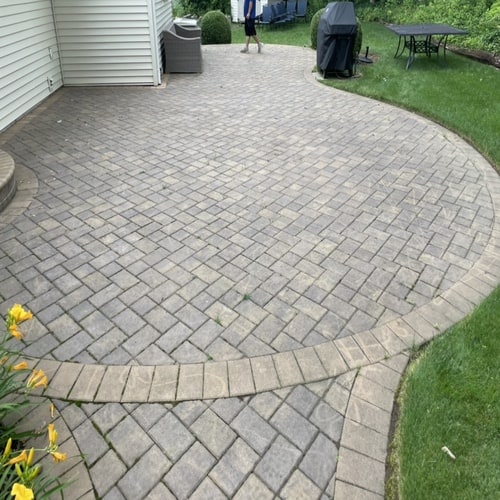
Professional paver restoration can address cracked or chipped surfaces, sunken or shifted sections, eroded joints, efflorescence (the white chalky mineral deposits that show up on concrete pavers, especially in coastal areas like Nassau County’s South Shore), and general fading from UV exposure and weather. The process involves cleaning the surface thoroughly, repairing structural issues, re-sanding the joints with polymeric sand, and applying a quality sealer that protects against moisture, salt, and UV damage going forward.
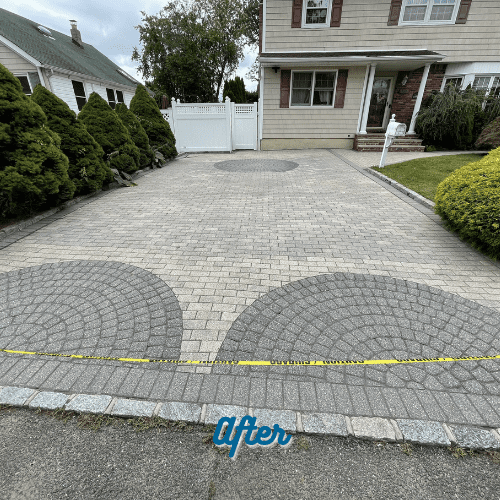
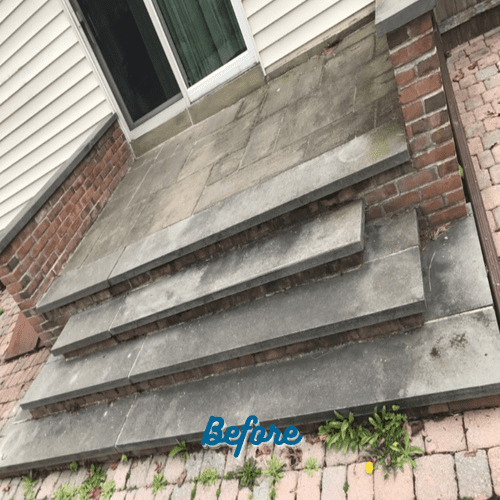
The result, when done properly, is a surface that genuinely looks new — not patched. Customers consistently describe it that way. The transformation from a stained, weed-filled, faded surface to a clean, sealed, uniform one is dramatic enough that people often assume the pavers were replaced entirely.
Restoration also makes financial sense in a market like Nassau County, where home values are high and curb appeal directly affects how a property is perceived. A well-maintained paver driveway or patio contributes to that value. A neglected one works against it. The cost of professional restoration is a fraction of full replacement — and in most cases, the outcome is comparable.
The key is catching problems before they become structural. Surface staining, minor cracking, and joint erosion are all restorable. A base that has fully failed beneath the pavers is a different situation. Most homeowners who call a specialist are dealing with the former, not the latter.
Long Island Landscapers: How to Match the Right Company to Your Actual Project
The term “landscaping company” covers a lot of ground on Long Island. Some companies focus on weekly lawn maintenance. Others specialize in full landscape design and installation — planting, grading, drainage, the whole picture. Others work primarily in hardscape: patios, driveways, retaining walls, outdoor kitchens. And within hardscape, there’s a meaningful difference between companies that install new pavers and companies that maintain and restore existing ones.
Knowing which category your project falls into helps you filter the list quickly. If your pavers are already installed and you need them cleaned, sealed, or restored, you don’t need a landscape designer. You need a paver specialist — someone whose entire business is built around that service, not someone who offers it alongside a dozen other things.
Questions Nassau County Homeowners Should Ask Before Hiring Any Landscaping or Paver Company
Most homeowners skip the vetting step and go straight to price comparison. That’s understandable — but it’s also how people end up with sealers that peel after one winter, or joints that look worse than before the crew showed up.
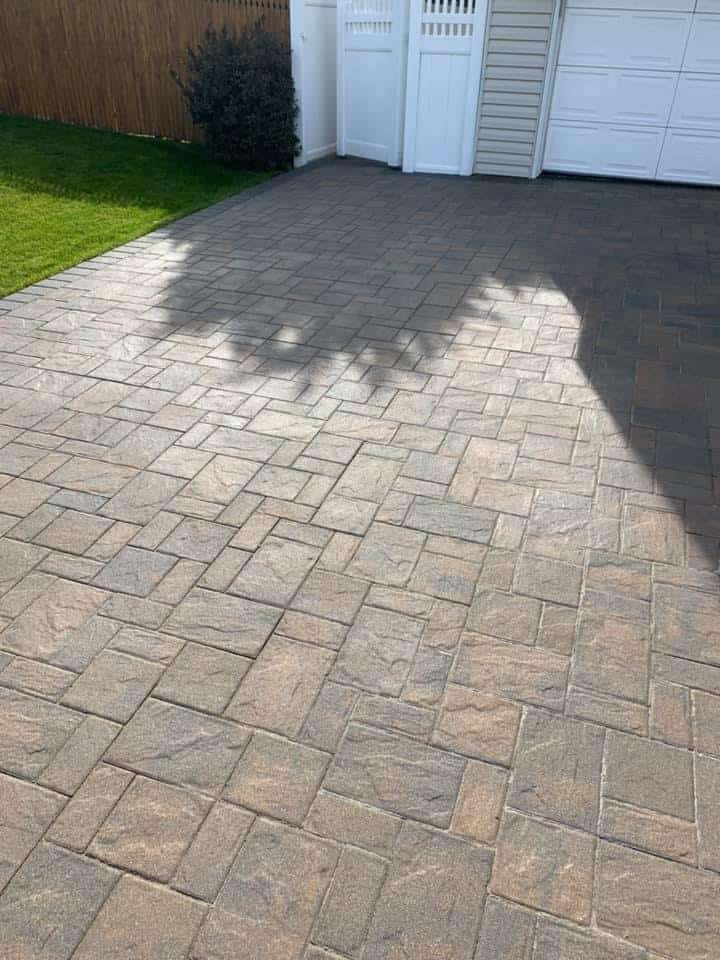
A few questions worth asking before you sign anything: Are you licensed in Nassau County, and can you provide your HIC license number? What equipment do you use for surface cleaning? What sealer products do you use, and are they UV-resistant and salt-tolerant? How do you handle weather — will you reschedule if conditions aren’t right for sealing? And can you show me examples of completed work on Long Island properties?
That last one matters more than people realize. Long Island’s climate is specific. A contractor who works primarily in a different region may not have experience with the salt air and freeze-thaw conditions that Nassau County properties deal with every year. You want someone who has seen what happens to pavers on the South Shore after a hard winter — and knows exactly how to address it.
References and reviews are worth reading carefully, too. Look for specifics: did the crew show up on time, was the scope of work completed as quoted, and does the finished surface actually look the way the customer expected? Generic five-star reviews with no detail are less useful than a review that mentions specific services, names a technician, and describes the before-and-after.
Financing is also worth asking about. We offer payment options that make professional-grade restoration more accessible without requiring the full cost upfront. It’s worth knowing what’s available before you assume the only option is paying in full.
FAQs: What Long Island Homeowners Ask Most About Paver and Landscaping Services
**How often do pavers need to be sealed in Nassau County?** For most Nassau County properties, every two to four years is a reasonable range — but the honest answer depends on the specific conditions your pavers are exposed to. South Shore communities near the bays and barrier beaches deal with more salt air and humidity than properties further inland, which tends to accelerate surface wear. High-traffic areas like driveways also need attention more frequently than a backyard patio that sees lighter use. We assess your specific surface and give you an honest timeline based on what your pavers are actually dealing with.
**Can I pressure wash my pavers myself?** You can, but there’s a real difference between what a consumer-grade pressure washer does and what professional equipment produces. Standard wands apply uneven pressure that can streak the surface or, at higher settings, actually damage the paver face. A commercial surface cleaner covers the area evenly without those risks. Beyond that, cleaning is only part of the job — if the joints aren’t re-sanded afterward and the surface isn’t sealed, you’ve removed the biological growth and surface dirt but left the pavers unprotected. In Nassau County’s climate, that protection matters.
**What is efflorescence, and is it a serious problem?** Efflorescence is the white, chalky residue that forms on concrete and brick pavers when water moves through the material and deposits minerals on the surface. It’s especially common in coastal Nassau County, where humidity and moisture exposure are higher. It’s not structurally dangerous, but it can be persistent and it does affect appearance significantly. It requires a specific chemical treatment to remove properly — regular pressure washing doesn’t fully address it. If you’re seeing white deposits on your pavers, that’s worth mentioning when you call for a quote.
**Do landscaping companies in Nassau County need to be licensed?** Yes. Nassau County requires home improvement contractors — including those performing paver installation, repair, or restoration — to hold a license issued by the Nassau County Department of Consumer Affairs. Before hiring anyone, ask for their license number and verify it. Working with an unlicensed contractor leaves you without legal recourse if the work is substandard or something goes wrong on your property.
Finding the Right Paver or Landscaping Contractor in Nassau County, NY
The search for landscaping companies near you in Nassau County doesn’t have to be complicated — but it does require knowing what you’re actually looking for. Specialization, proper equipment, quality materials, and local experience with Long Island’s specific climate conditions are the things that separate a good outcome from a frustrating one.
If your pavers need cleaning, sealing, or restoration, the most important thing you can do is talk to someone who does this work specifically — not as a side service, but as their entire focus. The results are different. The knowledge is different. And in a market like Nassau County, where winters are hard and salt air is a real factor, that difference shows up in how long the work holds.
We’ve been doing this work across Nassau and Suffolk counties for years, with nearly 50 years of combined team experience and a track record of results that homeowners consistently describe as transformative. If you’re ready to get a straight answer about what your pavers actually need, reach out to us for a quote.
Article details:
- Published by:
- Paver Savers
- Published to:
- Last modified:
- October 8, 2026
Share:
Continue learning: