Brick vs Concrete Pavers for Long Island
Not sure whether brick or concrete pavers are right for your Long Island property? Here's what actually matters before you choose.
Share:
Summary:
If you’re trying to decide between brick and concrete pavers — or you already have one and you’re wondering if you made the right call — you’re not alone. It’s one of the questions we hear most from Nassau County homeowners, and the honest answer is: it depends on more than personal taste.
Long Island’s climate, your property’s location, and how much maintenance you’re willing to do all factor in. This page walks through the real differences — durability, cost, maintenance, and how each material performs in the specific conditions Nassau County throws at it — so you can make a decision with confidence.
Concrete Paver Durability: How Well Do They Hold Up on Long Island?
Concrete pavers are manufactured to meet ASTM C936 standards, which require a minimum compressive strength of around 8,000 to 8,500 psi. That’s not a marketing number — it means they’re engineered to handle significant load and pressure. Under normal conditions with proper installation and regular sealing, concrete pavers typically last 15 to 30 years.
The catch in Nassau County is the freeze-thaw cycle. We see 30 to 40 of them every winter. Water that works its way into an unsealed paver expands by 9% when it freezes — and that pressure builds from the inside out. Over time, it’s enough to crack surfaces and shift pavers out of alignment. Concrete pavers handle this well when they’re sealed and maintained. When they’re not, the damage accumulates quietly until it becomes obvious.
How Nassau County's Salt Air and Road Chemicals Affect Concrete Pavers
Here’s something that doesn’t come up enough in generic paver guides: road salt. Nassau County’s major roads — Sunrise Highway, the Southern State Parkway, Meadowbrook Parkway — get heavily treated in winter. If your driveway is anywhere near a treated road, you’re getting salt splash whether you notice it or not. Rock-salt-infused concrete can hold up to 10% extra water, which makes every freeze-thaw cycle more destructive.
For homeowners in south shore communities like Atlantic Beach, Long Beach, Lido Beach, and Oceanside, there’s the added factor of salt air coming off the Atlantic year-round. Salt particles are hygroscopic — they attract and hold moisture — which accelerates surface deterioration on any unsealed hardscape. Concrete pavers in these areas need to be sealed on the shorter end of the recommended cycle, which is every three to five years under normal conditions.
The good news is that dense concrete pavers are actually less porous than clay brick, which gives them a meaningful advantage in high-salt environments. When properly sealed, they resist salt penetration well. When the sealer wears down and isn’t replaced, that protection disappears fast. That’s not a flaw in the material — it’s just the maintenance reality of living near the water on Long Island.
What we’ve seen after nearly 50 years of combined experience working on Nassau County driveways and patios is that the pavers that hold up best over time aren’t necessarily the most expensive ones. They’re the ones that got proper base preparation at installation and consistent paver sealing every few years after. The material matters, but the maintenance matters just as much.
What Happens When Concrete Pavers Go Too Long Without Sealing
Concrete pavers are porous by nature. The sealer is what creates a barrier between the surface and everything Long Island throws at it — salt, moisture, UV exposure, oil from vehicles, and the organic growth that builds up in Nassau County’s humid summers. When that barrier wears away and isn’t refreshed, the paver starts absorbing all of it.
The first sign is usually fading. The color that looked sharp when the pavers were new starts to look washed out and uneven. Then you might notice efflorescence — those white, chalky deposits that appear when mineral salts migrate from inside the paver to the surface. It’s not structural damage at that point, but it’s a sign that moisture is moving through the material in ways it shouldn’t be. Left alone, it progresses to surface pitting, joint erosion, and eventually shifting or cracking.
The other thing that happens when joints aren’t maintained is biological growth. Algae, mold, and mildew thrive in Nassau County’s humid conditions, especially on shaded patios and pool decks. Once they take hold in the joints, they’re difficult to remove without professional equipment. Regular joint sand — the kind many contractors use — also washes out over time, which opens gaps that invite weeds and ants. Polymeric sand, which hardens when activated with water, is the standard we use on every project because skipping it creates problems that show up within a season or two.
Concrete pavers that get cleaned and resealed on schedule look great for decades. The maintenance schedule isn’t optional — it’s built into what makes the material work.
Brick Paver Maintenance: What Clay Pavers Actually Need in Nassau County
Brick pavers — more precisely, clay pavers — are often described as the low-maintenance option, and that’s largely accurate. They don’t require sealing the way concrete does. Clay is fired at high temperatures during manufacturing, which gives it a natural density and color that doesn’t fade the way a pigmented concrete surface can. With basic care, brick pavers can last 50 years or more. Some well-maintained installations push past 100.
That said, “low maintenance” doesn’t mean “no maintenance.” On Long Island, brick pavers still accumulate algae, mold, and efflorescence over time, especially in shaded areas or near the water. The difference is that neglecting them doesn’t carry the same structural risk as neglecting concrete — but they’ll still look worn and stained without periodic professional cleaning.
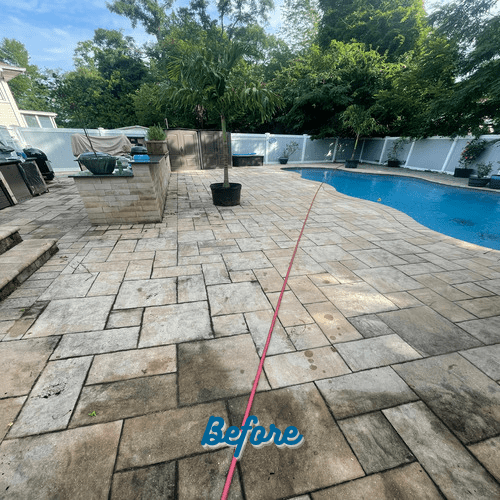
Are Brick Pavers a Good Choice for Long Island's Coastal Communities?
This is where the conversation gets more nuanced. Clay brick is more porous than dense concrete, which matters a great deal in coastal Nassau County. Properties in Atlantic Beach, Long Beach, Bayville, and Sea Cliff face persistent salt air exposure that accelerates deterioration on any porous surface. Salt works its way into the material, and when water follows — which it does, constantly, in a coastal environment — the freeze-thaw cycle amplifies the damage.
For south shore properties in particular, we’ve seen brick paver driveways and patios age significantly faster than comparable concrete installations simply because of the porosity difference. That doesn’t mean brick is the wrong choice near the water — it means the decision requires realistic expectations about cleaning frequency and the possibility of individual unit replacement over time.
Brick pavers do have one clear advantage that concrete can’t fully replicate: the way they age. A well-worn brick paver surface has a character and warmth that many homeowners prefer to the more uniform look of concrete. The color variation in clay brick deepens naturally over time rather than fading. For patios, garden paths, and decorative applications where appearance matters more than heavy load-bearing performance, brick often wins on aesthetics alone.
For driveways — especially in communities like Massapequa, Wantagh, or Levittown where road salt exposure is real and vehicle loads are constant — dense concrete pavers tend to be the more practical long-term choice. The right answer depends on where on your property you’re installing them and what you’re asking them to do.
Paver Material Costs: What Brick vs Concrete Actually Runs in Nassau County
Cost is usually one of the first questions, and the numbers in Nassau County are fairly consistent across the market. Concrete pavers run approximately $16 to $19 per square foot installed. Brick pavers come in a bit higher — typically $17 to $22 per square foot depending on the style and complexity of the pattern. A standard 16-by-18-foot patio lands somewhere between $4,600 and $5,600 for concrete; a two-car brick driveway at 480 square feet can run $8,600 to $11,000.
Those are the installation numbers. The more complete picture includes what each material costs to maintain over time. Concrete pavers need professional resealing every three to five years, which is an ongoing investment. Brick pavers don’t require sealing but benefit from professional paver cleaning every two to three years to stay looking sharp. Over a 20-year period, the total cost of ownership tends to be closer between the two materials than the initial price difference suggests.
There’s also the question of what happens if something goes wrong. One of the genuine advantages of both brick and concrete paver systems — compared to poured concrete — is that individual units can be lifted and replaced without disturbing the surrounding surface. That’s a meaningful long-term value, especially in Nassau County where tree roots, ground movement, and freeze-thaw shifting are common. A cracked poured concrete driveway often means a full resurfacing job. A shifted or cracked paver usually means replacing a handful of units and re-stabilizing the joints.
Nassau County’s median home value sits around $684,700, and homes here are currently selling above asking price. In that kind of market, a well-maintained paver driveway or patio isn’t just about appearances — it’s a real factor in what buyers are willing to pay. Professionally maintained pavers can return 50 to 75 percent of their cost at resale, and in a market as competitive as Nassau County’s, curb appeal carries real weight.
Which Paver Is Right for Your Nassau County Property?
There’s no universal answer here, and anyone who tells you otherwise is oversimplifying. Concrete pavers offer strong durability, design flexibility, and solid performance in freeze-thaw conditions when they’re properly sealed and maintained. Brick pavers offer longevity, natural character, and lower sealing requirements — but they’re more vulnerable to salt penetration in coastal environments and need realistic maintenance expectations.
What both materials have in common is this: how they’re installed and how they’re cared for over time matters more than which one you choose. The best paver on Long Island is the one that gets a proper base, proper joints, and regular professional maintenance.
If you’re not sure what you have, how old it is, or what condition it’s actually in, that’s a perfectly normal place to start. We’ve been working with Nassau and Suffolk County homeowners for over 20 years, and we’re happy to take a look and give you a straight answer about what your pavers need — whether that’s cleaning, sealing, restoration, or just some honest advice.
Article details:
- Published by:
- Paver Savers
- Published to:
- Last modified:
- September 29, 2026
Share:
Continue learning: