Paver Restoration Cost: Nassau County Fair Pricing
Not sure what paver restoration actually costs on Long Island? Here's a straightforward breakdown — no fluff, no surprises.
Share:
Summary:
You look at your driveway or patio and something’s clearly off — weeds pushing through the joints, pavers that have shifted, surfaces that used to look sharp now faded and stained. The question isn’t whether it needs attention. It’s whether it’s worth fixing, what it’s going to cost, and whether you can trust whoever you hire to actually do it right.
Those are fair questions. And if you’re a Nassau County homeowner, the answers depend on more than just square footage. This page gives you a straight look at what paver restoration costs here on Long Island, what drives the price up or down, and what a complete, quality job actually includes.
Paver Cleaning Cost: What Nassau County Homeowners Actually Pay
Cleaning is where every restoration job starts — and it’s not just running a pressure washer over the surface. Professional paver cleaning uses high-volume equipment designed specifically for paver surfaces. Here in Nassau County, that typically runs between $0.25 and $0.55 per square foot, depending on the condition of the surface and what’s on it.
Moss, algae, mold, oil staining, and efflorescence all require different treatment. A patio that’s been neglected for a few years takes more time and product than one that was sealed two seasons ago. That’s not a reason to pad the bill — it’s just the reality of what thorough cleaning involves.
Skipping or rushing the cleaning phase is where a lot of cheap jobs fall apart. Sealing over a dirty surface traps contaminants underneath and causes the finish to cloud, peel, or fail within a season. Done right, cleaning is what makes everything else last.
Why Nassau County's Climate Makes Professional Cleaning More Important
Long Island’s winters are hard on pavers in ways that warmer climates simply don’t deal with. Every freeze-thaw cycle pushes water into unsealed joints, where it expands, contracts, and gradually works the pavers loose. Road salt and calcium chloride — spread heavily across Nassau County roads and driveways from November through March — migrate onto paver surfaces and accelerate staining, surface erosion, and color loss. By the time spring rolls around, you’re often dealing with salt residue, biological growth, and joint material that’s partially washed out.
That’s not a cosmetic problem. It’s a structural one in the making. And it’s why cleaning in this market isn’t a simple rinse — it’s a targeted process. Efflorescence, which shows up as white mineral deposits on paver surfaces, is common in Nassau County homes near the water, including communities like Long Beach, Oceanside, and Port Washington, where coastal humidity compounds the issue. Treating it correctly requires specific products and knowledge of what’s causing it.
Homes in older Nassau County neighborhoods — think the post-war streets of Levittown, New Cassel, or Plainedge — often have pavers that are decades old and carrying years of accumulated damage. These surfaces need more than a surface wash. They need someone who understands what they’re looking at and knows how to address it without damaging the material underneath.
We use a professional 20-inch surface cleaner on every job — not a consumer-grade pressure washer. The difference shows in the result. Even coverage, no streaking, and a clean surface that’s actually ready to be sealed. It’s a small detail that makes a significant difference in how long the finished job holds up.
What's Typically Included in a Professional Paver Cleaning Job
A thorough paver cleaning isn’t a single step — it’s a sequence. It starts with removing debris and plant material from the surface and joints, followed by a deep clean using professional-grade equipment. Stubborn staining from oil, rust, mold, or algae gets spot-treated before the main wash. Old or loose joint sand is cleared out in preparation for what comes next.
That last part matters more than most homeowners realize. Joint sand is what keeps pavers stable. When it erodes — which it does over time, especially through freeze-thaw cycles and heavy rainfall — pavers start to shift, edges lift, and weeds find their way in. Cleaning without addressing the joints is a half-measure. It might look better temporarily, but the underlying problem is still there.
This is why we include polymeric sand on every sealing job, not as an add-on, but as a standard part of the process. Polymeric sand is designed to harden when activated with water, locking the joints against weed infiltration, ant activity, and paver movement. It’s the step that separates a job that holds up for years from one that looks good for a season and then starts to deteriorate again.
If you’ve had pavers cleaned before and found the weeds came back within a year, there’s a good chance the joints weren’t properly addressed. That’s a common outcome when cleaning is treated as a standalone service rather than the first phase of a complete restoration.
Paver Sealing Cost: What Long-Term Protection Runs in Nassau County
Sealing is where the investment gets protected. In Nassau County, professional paver sealing typically runs between $0.75 and $2.00 per square foot, depending on the paver material, the size of the area, and the sealer selected. For a 200 square foot patio that includes cleaning, polymeric sand, and sealing, most homeowners are looking at somewhere in the $300 to $550 range — though our local labor market and project specifics can push that higher.
The sealer itself matters. Professional-grade sealers from reputable manufacturers behave differently than what you’d pick up at a home improvement store. They bond properly to the surface, hold up under UV exposure and freeze-thaw stress, and don’t cloud or peel when applied correctly. A cheaper sealer might look fine on day one and fail by the following spring.
Quality sealers, applied to properly cleaned and prepped surfaces, typically last three to five years before reapplication is needed. That’s a reasonable maintenance cycle for a surface that handles daily foot traffic, vehicle weight, and Long Island winters.
Full Paver Restoration Cost vs. Replacement: The Nassau County Math
This is the question that most homeowners are really asking when they search for paver restoration cost: is it cheaper to fix what’s there, or start over? The numbers are pretty clear on this.
Professional paver restoration — cleaning, polymeric sand, and sealing — runs roughly $2 to $4 per square foot for a complete job. Full paver replacement on Long Island, including material and labor, runs $20 to $35 per square foot or more. On a 500 square foot driveway, that’s the difference between a $1,000 to $2,000 restoration and a $10,000 to $17,500 replacement. For larger driveways or natural stone surfaces, the gap widens further.
The key variable is the foundation. If the base beneath your pavers is still structurally sound — meaning the settling is surface-level, not caused by base failure — restoration is almost always the better move. We assess this before recommending anything. If the foundation has failed, we’ll tell you. But in most cases, pavers that look worn, stained, or shifted can be brought back without tearing everything out.
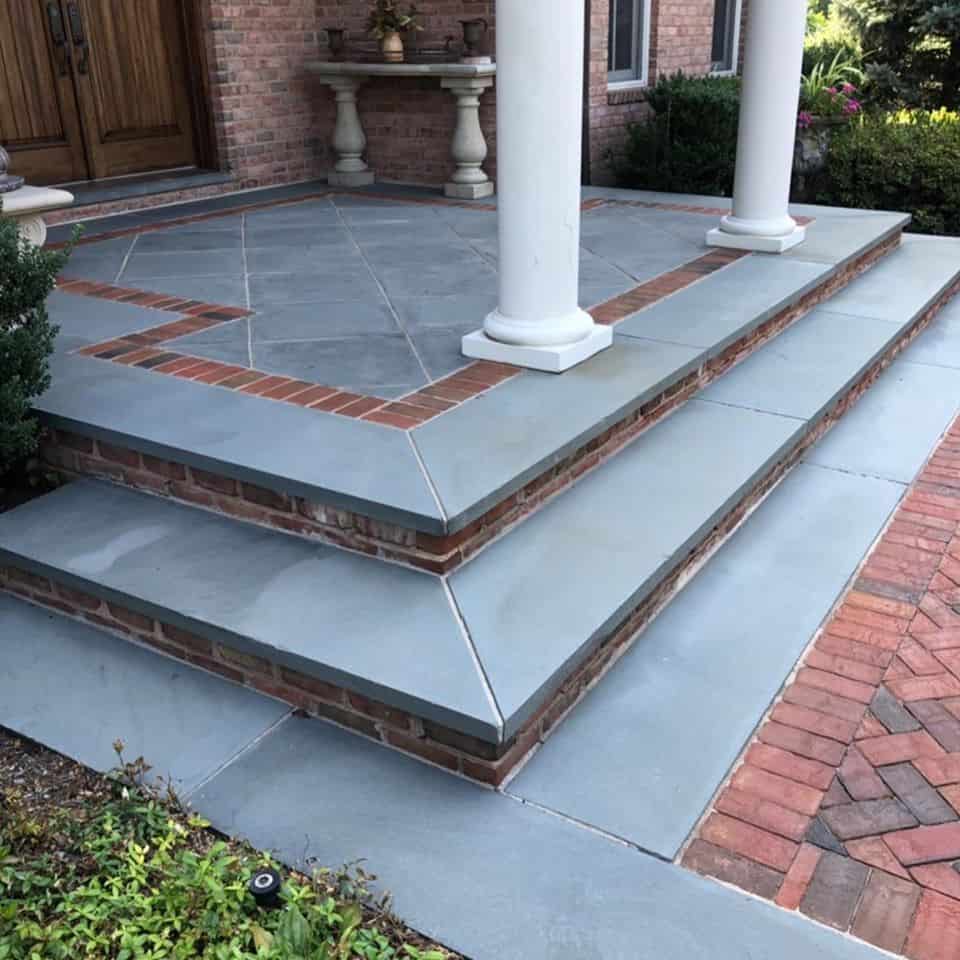
Homeowners in Nassau County’s higher-value communities — Garden City, Manhasset, Old Westbury, Roslyn — often have natural stone installations: bluestone patios, travertine pool surrounds, flagstone walkways. These materials are expensive to replace and, in many cases, no longer available in the same cut or finish as the original installation. Restoration isn’t just the cheaper option in these situations — it’s often the only way to preserve what’s already there.
The ROI case is also worth considering. Pavers can return up to 109% of project cost in added home value. In a county where median home values regularly exceed $500,000, curb appeal isn’t a cosmetic concern — it’s a financial one. A restored driveway or patio signals maintained property and makes a real impression on buyers, appraisers, and neighbors alike.
Nassau County Contractors: What Fair Market Pricing Looks Like and How to Spot a Low-Ball Quote
Getting multiple quotes is smart. But understanding what’s actually in each quote is what separates a good decision from an expensive mistake.
A complete paver restoration quote for Nassau County should include professional cleaning with appropriate equipment, removal of old joint sand, polymeric sand application, and a quality sealer suited to your specific paver material. If a quote is significantly lower than others you’ve received, the most likely explanation is that one or more of those steps has been removed. Skipping polymeric sand is the most common shortcut — it saves the contractor time and material cost, but leaves your pavers vulnerable to the exact problems you were trying to solve.
Nassau County requires home improvement contractors to register with Nassau County Consumer Affairs. That’s a local licensing layer that exists specifically to protect homeowners. Any legitimate contractor working in the county should be able to confirm their registration. We’re fully licensed and insured — not just at the state level, but in compliance with Nassau County’s specific requirements.
Experience in this trade also isn’t interchangeable with general construction or landscaping experience. Paver sealing requires knowledge of material chemistry, sealer compatibility, and application conditions. Applying the wrong sealer to a natural stone surface, or sealing in humid conditions without proper prep, can cause hazing, whitening, or peeling that’s expensive to correct. We’ve spent over 20 years — with nearly 50 years of combined experience across our team — working specifically on paver cleaning, sealing, and restoration on Long Island. That focus is intentional.
We also offer financing options for larger restoration projects. A full driveway restoration or commercial hardscape job can be a significant investment, and we’d rather work with you on timing than have you put off a job that’s going to keep getting worse. No competitor in this market is offering that combination of local expertise, transparent pricing, and flexible payment — and we think it matters.
Ready to Get a Fair Quote on Paver Restoration in Nassau County?
The short version: paver restoration costs a fraction of what replacement costs, and in most cases, it delivers results that are hard to distinguish from new. The real question isn’t whether you can afford to restore your pavers — it’s whether you can afford to keep putting it off while Nassau County’s winters do more damage every season.
A fair quote is transparent about what’s included, uses professional equipment and quality materials, and comes from a contractor who’s licensed, insured, and accountable to this community. Those aren’t high standards — they’re the baseline.
If you’re ready to find out what your specific project would cost, reach out to us. We’ll take a look at what you’re working with, give you a straight answer, and explain exactly what the job involves before you commit to anything.
Article details:
- Published by:
- Paver Savers
- Published to:
- Last modified:
- September 11, 2026
Share:
Continue learning: