Paver Sealing in Nassau County: Professional vs DIY Cost Analysis
Thinking about sealing your pavers yourself? Here's what the cost comparison actually looks like before you commit to either option.
Share:
Summary:
You’ve done the research. You’ve seen the Home Depot sealers for $40 a bucket. You’ve watched a few YouTube videos. And now you’re wondering whether it’s actually worth hiring someone — or whether you’re just paying for a label.
That’s a fair question, and it deserves a straight answer. This page breaks down what professional paver sealing actually costs, what DIY sealing actually costs, and where the two numbers stop being comparable. By the time you finish reading, you’ll have a clear enough picture to make a confident decision — without anyone trying to sell you on something you don’t need.
What Paver Sealing Actually Costs — Professional vs. DIY
The upfront numbers aren’t that far apart, which is exactly why this comparison trips people up. DIY materials for a standard 500 square foot patio run somewhere between $150 and $300 when you account for the sealer, cleaner, and basic application tools. Professional paver sealing for the same area typically runs between $750 and $1,625, depending on condition, paver type, and what prep work is needed.
On paper, that looks like a $400 to $1,000 gap in your favor if you go DIY. In practice, that gap closes fast — and sometimes reverses entirely.
Why DIY Paver Sealing Ends Up Costing More Than Expected
The $270 average savings from doing it yourself disappears the moment something goes wrong — and a lot can go wrong with paver sealing if you haven’t done it before.
The most common failure is white haze. It happens when sealer gets applied over pavers that haven’t fully dried, or when the humidity is too high, or when too much product gets put down in one coat. The sealer traps moisture underneath and turns milky. It doesn’t just look bad — it’s difficult to fix. Stripping failed sealer off a patio requires chemical strippers, time, and in most cases a second full cleaning before you can reapply. By the time you’ve bought the stripper, redone the prep, and purchased new sealer, you’ve often spent more than a professional job would have cost from the start.
There’s also the issue of product quality. The sealers available at hardware stores are consumer-grade formulas designed for ease of application, not longevity. They typically last one to two years before they start breaking down. Professional-grade sealers — the kind we use, sourced from established manufacturers — are built to last three to five years. That’s not a marketing claim. It’s a formulation difference. Over a ten-year period, a homeowner using consumer sealers may go through five or more applications. Someone using professional-grade product every few years does it twice, maybe three times, with better results each time.
And then there’s the equipment gap. Deep – cleaning pavers before sealing isn’t something a standard pressure washer handles well. We use commercial 20-inch surface cleaner equipment that delivers uniform, thorough cleaning across the entire surface. A consumer pressure washer — even a decent one — tends to leave streaks, miss embedded staining, and create an uneven base for the sealer to bond to. Sealing over a surface that wasn’t properly cleaned doesn’t just look worse. It locks in whatever was there before.
The Step Most DIYers Skip — And Why It Matters
There’s a reason professional paver sealing takes more than one day. The process isn’t clean-and-seal. It’s clean, dry completely, address the joints, then seal — and each of those steps has a failure point if it’s rushed.
Polymeric sand is one of the most overlooked parts of the job. It goes into the joints between pavers and locks them in place once it’s activated with water. Without it — or with old, eroded joint sand that was never replaced — weeds come back, ants tunnel through, and the pavers start shifting. Sealing over unstable joints just preserves the problem. We include polymeric sand installation as part of a complete sealing job because skipping it means the results don’t last.
Drying time is the other piece most people underestimate. After cleaning, pavers need a full 24 to 48 hours to dry before sealer goes down. That’s not a conservative estimate — it’s the minimum. Sealing too soon is the direct cause of the white haze problem described above. It’s also why weather matters so much. Sealing in high humidity, in temperatures below 50°F, or with rain in the forecast creates conditions where the sealer can’t cure properly. We schedule jobs around weather windows, not just calendar availability, because the timing of application is part of what makes it last.
This level of process discipline is hard to replicate on a Saturday afternoon. Not because homeowners aren’t capable, but because the variables — humidity, surface temperature, drying time, product compatibility — require experience to read correctly. A professional who has done this hundreds of times across Nassau County homes develops a feel for those conditions that a first-time DIYer simply doesn’t have yet.
Why Paver Sealing in Nassau County Is a Different Calculation Than Most Markets
Nassau County isn’t the easiest environment for hardscape. Between the winters, the coastal air, and the de-icing salt that ends up on every driveway from December through March, unsealed pavers here take a beating that pavers in warmer or more inland markets simply don’t face.
Long Island sees 30 to 40 freeze-thaw cycles every winter. Each one pushes water into the micro-cracks of paver surfaces, freezes it, expands it, and widens those cracks a little more. Over several seasons, that process turns small surface issues into structural ones. Sealing doesn’t make pavers indestructible, but it creates the moisture barrier that slows that cycle down significantly.
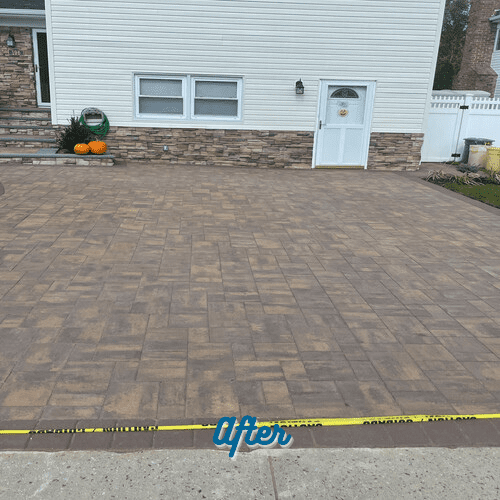
What Nassau County's Climate Does to Unsealed Pavers Over Time
The salt air exposure in Nassau County is worth understanding if you live anywhere near the water. South Shore communities like Long Beach, Atlantic Beach, and Massapequa deal with ocean air year-round. North Shore towns like Port Washington and Great Neck get it from the Sound. That salt doesn’t just sit on the surface — it works into the joints, erodes the sand, and accelerates the breakdown of calcium-based paver materials over time.
Add in the humidity of Long Island summers, which creates ideal conditions for algae, mold, and mildew to take hold on shaded patio surfaces and pool surrounds, and you’re looking at a maintenance environment that’s more demanding than most of the country.
The consequence of skipping sealing in this climate shows up faster than people expect. Unsealed pavers in Nassau County can fade to the point of looking like bare concrete in as little as seven years. That’s not wear from heavy use — that’s just weather doing what weather does when there’s no protective barrier in place. A paver driveway or patio here represents a $10,000 to $25,000 investment in most cases. Professional sealing at $500 to $1,500 every three to five years is a straightforward way to protect it. The math isn’t complicated.
Nassau County also has its own Home Improvement Contractor licensing requirement, administered by the Department of Consumer Affairs. It’s separate from state licensing and applies to contractors doing this kind of work on residential properties. Hiring an unlicensed contractor in Nassau County isn’t just a quality risk — it’s a liability one. We’re fully licensed and insured, which matters for your protection as much as ours.
Questions Nassau County Homeowners Ask Before Hiring a Paver Sealing Company
One question we hear often is how frequently pavers actually need to be sealed. The honest answer is every three to five years with a professional-grade product applied correctly. If you’ve had someone use a consumer-grade sealer in the past, you might be looking at every one to two years before it starts to break down visibly. The resealing frequency is directly tied to product quality and application method — not just time.
Another common one: does sealing change the look of the pavers? It can, depending on the finish you choose. Sealers come in matte, satin, and gloss options, and some are formulated to enhance the natural color of the stone. The problem people run into with DIY sealing isn’t usually the finish they intended — it’s overapplication, which creates a plastic-looking sheen that’s hard to reverse. Professional application gives you control over the result because the product is being put down at the right thickness, in the right conditions, with the right equipment.
A question that comes up specifically from Nassau County homeowners: what about pavers that are already in rough shape? Faded, stained, with weeds coming up through the joints and sand that’s clearly been washing out for a few seasons? Sealing alone won’t fix structural issues, but restoration and sealing together can bring pavers back significantly further than most people expect. We’ve had customers in Massapequa and Valley Stream tell us their patios looked better after restoration than they did when they were first installed. That’s what happens when the surface is properly cleaned, re-sanded, and sealed with a product that actually brings the color back.
One more worth addressing: is it worth sealing older pavers, or should you just replace them? In most cases, restoration is worth it before replacement is considered. Replacement costs for a 500 square foot patio can run $7,500 to $12,500 or more in Nassau County. If the pavers themselves are structurally intact and the issues are surface-level — fading, staining, joint erosion — professional cleaning, restoration, and sealing is almost always the better financial decision.
So — Should You Seal Your Pavers Yourself or Hire a Professional?
If your pavers are in good shape, you have the right equipment, you’ve done this before, and the weather is cooperating — DIY sealing is a real option. But most homeowners asking this question are starting from scratch, working with consumer-grade products, and underestimating how much the prep work matters. That’s where the initial savings turn into a more expensive problem.
For Nassau County homeowners dealing with Long Island winters, coastal air, and pavers that represent a serious investment, professional sealing isn’t a luxury — it’s the more cost-effective choice over time. Better product, longer lifespan, no risk of failure costs, and a result that actually holds up through the freeze-thaw season.
If you want a straight answer on what your specific pavers need — and what it would actually cost — we’ve been doing this work across Nassau County for over 20 years. Reach out and we’ll take a look.
Article details:
- Published by:
- Paver Savers
- Published to:
- Last modified:
- August 17, 2026
Share:
Continue learning: