How Long Island, NY Weather Impacts Paving And Why Paver Sealing Matters
Around 116 freezing days a year put Long Island pavers through a lot. Here's what winter does to joints and surfaces, and how sealing fits in.
Share:

Summary:
Every spring, you walk out to the driveway after a Long Island winter and something looks off. One paver has dipped. The joints are thinner than you remember, and there’s a weed or two where there wasn’t one in October. It’s easy to blame a bad install or plain bad luck, but most of the time it’s just the weather doing what Suffolk County weather does. We’re going to walk through what winter does to a paver surface, where sealing helps and where it doesn’t, and what to look for so you’re not guessing when you hire someone. First, the winter itself.
How Long Island Winters Wear Down Paver Driveways And Patios
Suffolk County sees roughly 116 freezing days a year, with the first frost showing up around October 25 and the last one hanging on until about April 21. The county’s hazard planning treats late October through mid-April as winter storm season. Snowfall swings a lot from year to year, you get tens of inches in a typical winter, and then a January 2022 blizzard drops nearly 25 inches on Islip in one go.
The cold itself isn’t the biggest issue. The back and forth is. Long Island winters tend to hover around 32°F, climbing above freezing in the afternoon and dropping below it overnight. Every swing gives water a chance to soak in and freeze again. Pavers look solid, but they’re porous, and that’s where the trouble starts.
What Does Freeze-Thaw Do To Pavers On Long Island?
Water that works its way into a paver expands by about 9% when it freezes. That doesn’t sound like much until you picture it happening inside a surface that has no room to give. The pressure opens tiny cracks, loosens the top layer, and over a few winters you start seeing flaking and rough patches. Contractors call it spalling. You’ll just call it “that corner doesn’t look right anymore.”
The sand is the other weak spot. Pavers sit on a bed of sand, and the joints between them are filled with more of it. When a nor’easter dumps heavy rain, or snowmelt runs across the driveway for days, that sand can wash out or get loose. Once the joints go soft, pavers can start to shift, and low spots can form where water collects. That water freezes, and the cycle feeds itself.
Add the humidity along the South Shore and you get another layer of trouble. Shaded patios and north-facing walkways stay damp, which invites moss, algae, and mildew, and that dampness is also behind a lot of the white haze people notice on pavers.
This is where sealing earns its place. A good sealer, along with stabilized joint sand, helps reduce how much water gets down into the pavers and the base underneath. We’d be misleading you if we said it makes pavers waterproof, because it doesn’t. What it does is give Long Island winters less to work with, and on a Suffolk County driveway that’s worth a lot.
Why Do Weeds And Ant Hills Keep Coming Up Between My Pavers After Heavy Rain?
Because the joints are usually the first thing to fail, and weeds and ants are the first sign you see. Once rain and freeze-thaw cycles wash sand out of the joints, you’ve got open gaps and a bit of soil, which is all a seed or an ant colony needs. A lot of homeowners across Nassau and Suffolk tell us the same thing: they pulled the weeds, and two weeks later they were back.
Pulling won’t solve it, and neither will pressure washing by itself. A pressure washer can blast out what’s left of the joint sand, so a yard that looked clean for a weekend ends up worse off. The fix is to clean the surface properly, level any sunken sections, refill the joints with polymeric sand, and then seal so that sand stays locked in place.
Does sealing stop weeds and ants for good? We won’t promise that, and you should be wary of anyone who does. What stabilized joints do is make it much harder for anything to get a foothold, and they hold up better against the heavy rain that washes loose sand away. Over time, joints still need a look, and sealer eventually needs refreshing.
If you’ve got a sunken section by the garage or a walkway that dips near the front steps, mention it when you call. Sealing over a low spot just locks in the problem, so repairs come first.
Paver Sealing On Long Island: What We Do Before The Sealer Goes Down
Most homeowners think of sealing as the last coat. In practice, it’s about the last 20% of the work. We’re a family-owned company based in West Babylon, NY, and we work on concrete, brick, bluestone, and natural stone pavers for homeowners and businesses across Nassau and Suffolk counties. Each material takes the sealer a little differently, so we don’t treat them all the same.
Our rule is simple: we don’t seal over problems. That means treating efflorescence and organic growth first, cleaning with hot-water pressure equipment, repairing and leveling where needed, refilling the joints with polymeric sand, and only then sealing. It’s more steps than a quick wash-and-coat, but it’s the order that holds up through a Long Island winter.
Why Do Pavers Turn Cloudy Or White After Sealing?
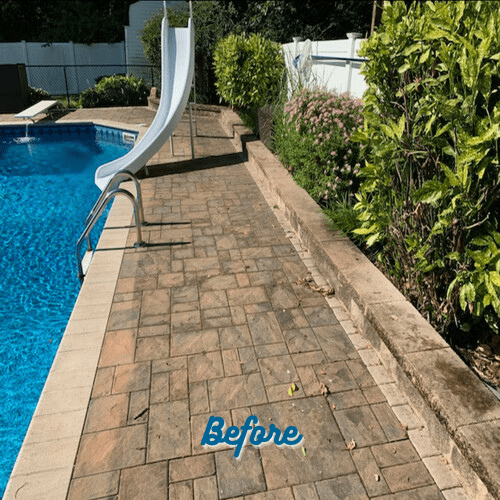
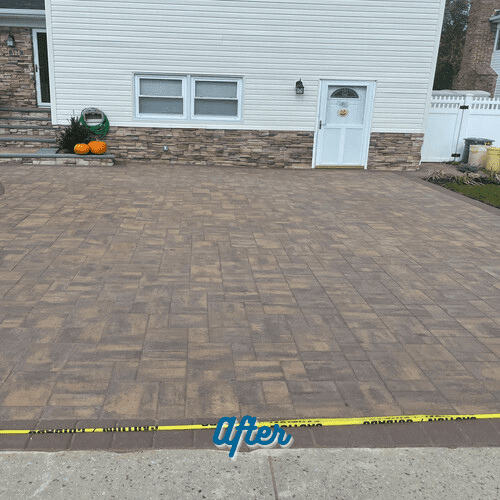
It’s the fear we hear most, and it’s a fair one. The usual cause is that the sealer went on over something it shouldn’t have. If pavers are even a little damp, that moisture gets trapped under the film. If there’s efflorescence on the surface, which is the natural white haze minerals leave behind as water works through concrete, sealing over it locks it in and leaves a cloudy finish that often has to be stripped off. Efflorescence is common in the first couple of months after new pavers go in, and it shows up more on dark pavers. It isn’t a defect, but it does need to be dealt with before sealing.
On Long Island, where humidity is high and shaded areas stay damp longer, this problem shows up more often than it does inland. We’ve seen sealer gone bad blamed on three main culprits: sealing before the pavers were dry, leaving too much polymeric sand in the joints, and not blowing the surface clean. That last one creates wide white lines in the joints that look like failing grout.
With our own process, the pavers get treated, cleaned, repaired, re-sanded, and given time to dry. Extra sand is cleared off the surface before any sealer is applied. Humid South Shore yards and shaded patios can take longer to dry out, so we plan around that instead of rushing it.
Finish matters too. Sealers come in natural or matte looks and enhanced, wet-look versions that deepen color. High-gloss film finishes can get slick, especially around a pool, so we talk through where the pavers are used before picking one.
When Should You Seal Pavers On Long Island, And What Else Do Homeowners Ask?
Timing first. Some local contractors point to September through early November as the window, and that’s reasonable given the first frost is usually around the end of October. But there’s no hard deadline. Sealer needs dry pavers and moderate temperatures to cure, so a dry week in spring works just as well as one in early fall. If you’ve missed the fall window, you haven’t missed your chance. Just don’t try to squeeze it in during a damp stretch in November because it feels late.
People also ask what happens if it rains after sealing. Fresh sealer needs time to cure before it sees rain or foot traffic, which is why we watch the forecast closely before we start. Nobody should seal right ahead of a Long Island nor’easter.
How often will you need to reseal? That depends on the sealer, how much traffic the surface gets, and how exposed it is. A shaded walkway and a sun-baked driveway won’t age the same. After we look at your pavers, we can give you a realistic idea instead of a number pulled from the air.
Can you do it yourself? You can, but pressure washing the wrong way can damage pavers and strip the joint sand, and a mistake on a large driveway is expensive to undo. Cost depends on the size of the area, the condition of the pavers, the finish, and whether cleaning, re-sanding, or repairs are included. That’s why we give a free estimate after seeing the job in person.
Last, ask any contractor for proof of license and insurance. Nassau County requires a Home Improvement Contractor license through its Department of Consumer Affairs, and we’re happy to show you ours.
Ready For Paver Sealing In Suffolk Or Nassau County? Start With A Free Estimate
Long Island winter works on your pavers slowly, through freeze-thaw swings, heavy rain, and sand that washes away a little at a time. Sealing helps by giving that water less to work with, and it works best when the pavers have been cleaned, repaired, re-sanded, and dried first. Skip those steps and you’re the one dealing with haze or weeds next year.
Contact Paver Savers today to schedule your free estimate and let our family-owned team protect your Long Island pavers against harsh freeze-thaw damage.
Article details:
- Published by:
- Paver Savers
- Published to:
- Last modified:
- November 17, 2026
Share:
Continue learning: