Paver Cleaning Services Cost vs DIY: Real Numbers
Thinking about cleaning your pavers yourself? Here's what the real numbers look like — and what most people don't find out until after the damage is done.
Share:
Summary:
You look at your driveway or patio and think: it’s not that bad, maybe I can just rent a pressure washer and knock this out in a Saturday. That’s a completely reasonable thought — and it’s exactly where things tend to go sideways.
The truth is, paver cleaning looks simpler than it is. Done wrong, it can strip joint sand, etch the surface, or lock in damage permanently once a sealer goes on top. This page gives you the real cost comparison, explains what professional paver cleaning actually involves, and helps you decide what makes sense for your property in Nassau County.
Pressure Wash Driveway Cost: Professional vs. DIY Breakdown
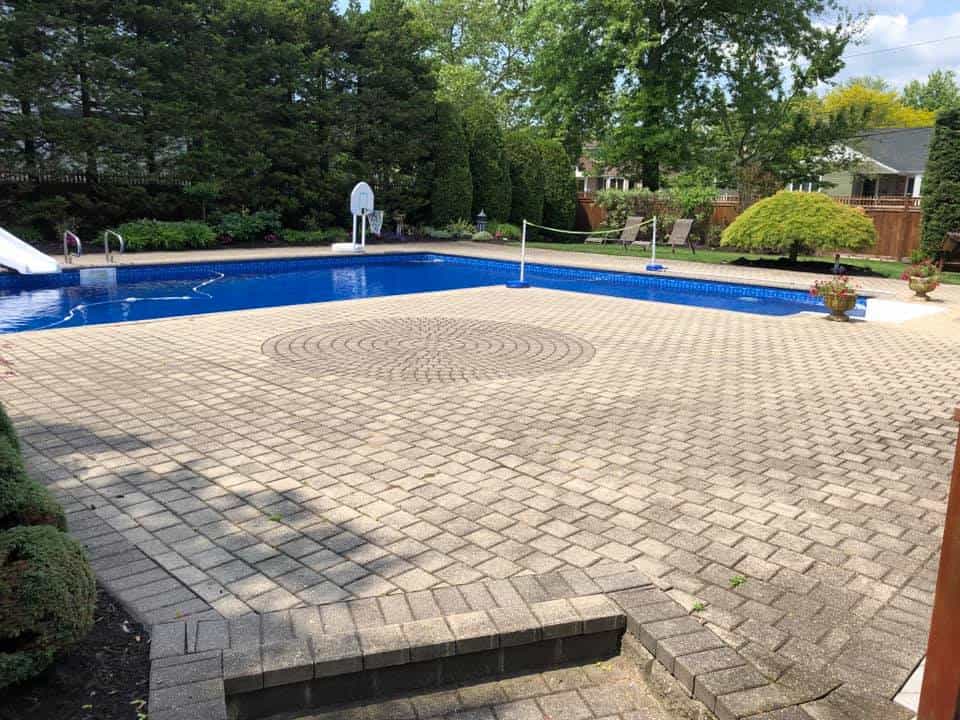
Most homeowners start with one question: what does it actually cost? For professional driveway pressure washing, the national average sits around $210, with most jobs ranging from $100 to $500 depending on size and condition. For paver-specific cleaning — which requires more care and the right equipment — professional rates typically run $0.25 to $0.50 per square foot for cleaning alone, and $1.50 to $2.00 per square foot when cleaning and sealing are bundled together.
DIY, on paper, looks cheaper. A pressure washer rental runs $55 to $145, and a 5-gallon bucket of paver sealer costs $50 to $150 at a hardware store. So yes, you can save roughly $270 compared to hiring a professional. The question is what you’re actually trading for that savings — and whether the result holds up.
Power Wash Driveway Cost: What's the Difference Between Pressure and Power Washing?
These two terms get used interchangeably, but they’re not the same thing. Standard pressure washing uses cold water at high force. Power washing adds heat to the equation — and that distinction matters more than most people realize.
For pavers with organic staining — moss, algae, mildew, the kind of dark green or black buildup that’s common on Long Island driveways after a wet spring — heated water breaks down biological growth far more effectively than cold pressure alone. Power washing typically costs $0.30 to $0.75 per square foot, compared to $0.20 to $0.40 per square foot for standard pressure washing. The premium is real, but so is the difference in results on the right type of surface.
What most homeowners renting equipment don’t have access to is a commercial 20-inch surface cleaner. That piece of equipment is what separates a professional result from a DIY one. A standard wand creates uneven pressure — you’ve seen the result: those faint stripe marks left behind after someone pressure washes a driveway. A 20-inch surface cleaner covers a wide, consistent path with uniform pressure, which means no stripes, no missed spots, and no accidental etching from holding the wand too close in one area.
There’s also the question of joint sand. Pavers aren’t a solid slab — they sit on a bed of sand, and the joints between them are filled with sand too. That sand is what keeps the surface stable. Pressure washing with the wrong technique or too much force blows that sand out, leaving gaps between pavers that allow weeds to take root and water to get underneath. We know how to clean thoroughly without disturbing the joints — and if the sand does need replacing, we handle that as part of the restoration process using polymeric sand, which locks in place and resists erosion.
Average Cost to Power Wash a House: How Paver Cleaning Fits the Bigger Picture
If you’ve looked into exterior cleaning for your home overall, you’ve probably seen that the average cost to power wash a house runs around $700, with most estimates ranging from $170 to $360 for the house alone and $200 to $480 for a patio or driveway separately. Those numbers give you a useful frame of reference: paver cleaning and sealing is one piece of a broader home maintenance budget, and it’s not the most expensive piece.
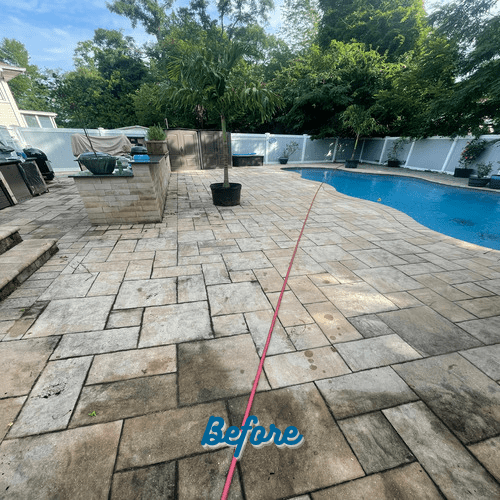
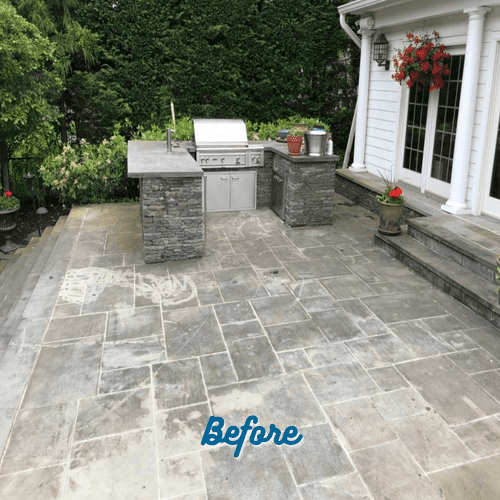
What it is, though, is one of the more consequential pieces to get wrong. The reason is sealing. Once a sealer goes on top of your pavers, whatever condition the surface was in underneath gets locked in. If you used the wrong sealer — say, a solvent-based product over a previously water-based application — you can end up with a white hazy film that’s nearly impossible to fix without stripping everything and starting over. If the surface wasn’t fully clean before sealing, the contamination is now sealed in. That’s one of the most common calls we get: someone tried to DIY, something went wrong, and now the pavers look worse than before.
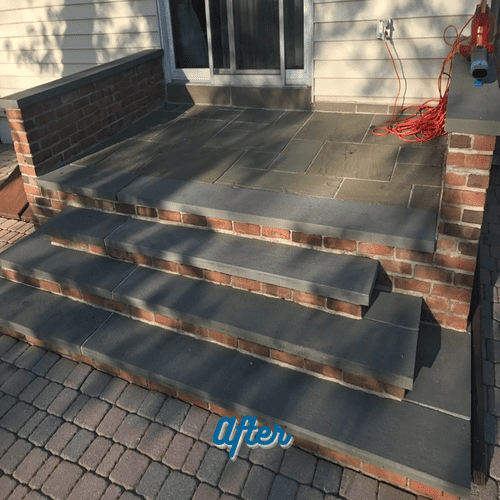
We factor into our pricing not just the labor and time, but the expertise to avoid those mistakes. We know which sealer is appropriate for your specific paver material — concrete, brick, natural stone, or bluestone all have different requirements. We know the right application conditions. And we know what “clean enough to seal” actually looks like, which is different from what it looks like to the naked eye after a quick rinse.
For Nassau County homeowners, there’s an additional layer to this. Properties in communities like Massapequa, Merrick, Wantagh, and Bellmore see significant road salt exposure every winter. Salt doesn’t just stain — it causes efflorescence, that chalky white deposit that appears on paver surfaces, and it degrades unsealed paver faces over time. Cleaning and sealing before winter is one of the most effective things you can do to protect a paver driveway or patio from the kind of damage that shows up over years, not weeks.
What Professional Paver Cleaning Services Actually Include
When you hire us for professional paver cleaning, you’re not paying for someone to show up with a pressure washer and rinse your driveway. The process is more involved than that — and the difference shows in how long the results last.
A proper professional cleaning starts with removing all plant matter, weeds, and organic debris from the joints. From there, the surface gets pressure washed with commercial-grade equipment using controlled technique. Joints are rinsed, edges are cleaned, and the surface is assessed for any areas that need spot treatment. If sealing is part of the job, the pavers need to dry completely before anything goes on — and that’s where weather-dependent scheduling becomes important. Rushing that step is how you end up with a sealer that traps moisture and clouds over.
How Often Do Nassau County Pavers Actually Need Professional Cleaning?
Most Long Island pavers benefit from professional cleaning every two to three years. That’s a general guideline, and the real answer depends on a few variables: how much sun or shade the surface gets, whether there are trees overhead dropping debris and tannins, how close the property is to the water, and how much vehicle or foot traffic the surface handles.
In Nassau County specifically, the freeze-thaw cycle is one of the biggest factors. Long Island winters bring repeated cycles of freezing and thawing — water gets into joints, freezes, expands, and slowly forces the surface apart. Sealed pavers resist this far better than unsealed ones because the sealer limits how much water penetrates in the first place. Homeowners in coastal communities like Long Beach, Atlantic Beach, or Oceanside face an added variable: salt air from the Atlantic accelerates surface oxidation and degradation on all outdoor materials, pavers included. For those properties, staying closer to a two-year cleaning and sealing cycle makes a real difference.
The other thing worth understanding is what happens when maintenance gets skipped too long. Pavers that go five or more years without cleaning tend to accumulate biological growth that bonds to the surface, joint sand that has washed out and been replaced by weeds, and staining that has worked its way into the paver face. At that point, you’re not talking about a routine cleaning — you’re looking at a full restoration. That involves re-leveling any pavers that have shifted, replacing joint sand with polymeric sand, deep cleaning, and resealing. It’s more involved and more expensive than staying on a maintenance schedule, though it’s still often far cheaper than replacing the pavers entirely.
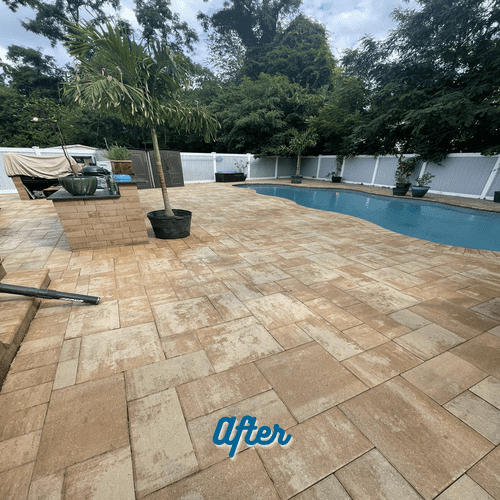
We’ve restored pavers that homeowners assumed were beyond saving — eight-year-old surfaces that hadn’t been touched since installation, and after the full process, the results were dramatic. That’s not an exaggeration; it’s what the right equipment, the right products, and the right process actually delivers.
Is DIY Paver Sealing Worth the Risk on Long Island?
For some home improvement projects, DIY is a perfectly reasonable choice. Paver sealing is one where the risk-to-reward ratio deserves a hard look before you commit.
The core problem isn’t the labor — it’s the margin for error. Sealer selection alone is a minefield. There are water-based sealers and solvent-based sealers, penetrating sealers and film-forming sealers, gloss finishes and matte finishes. Each has specific use cases, and applying the wrong one — or layering a solvent-based product over a water-based application — can cause adhesion failure, white staining, or a hazy film that doesn’t go away. Once that happens, the fix requires stripping the sealer off entirely, recleaning the surface, and starting over. The cost of that rework often exceeds what professional service would have cost in the first place.
There’s also the timing issue. Sealer needs to be applied in dry conditions, above a certain temperature, with enough drying time before rain. In Nassau County, where spring and fall weather can shift quickly, getting that window right matters. Apply too early in spring and you risk a cold snap. Apply before rain and the sealer won’t cure properly. We monitor conditions and reschedule proactively — that’s not a small thing when the alternative is a failed application.
And then there’s the physical reality of the job. Cleaning and sealing a 500-square-foot driveway is a full day of work, minimum — and that assumes everything goes smoothly. Renting equipment, transporting it, prepping the surface, applying the sealer evenly, cleaning up. For homeowners in communities like Garden City, Great Neck, or Plainview who are weighing a Saturday of labor against a professional result that lasts three to five years, the calculation shifts pretty quickly.
We also offer financing, which makes the cost of professional service easier to manage upfront. Protecting a paver investment that cost thousands to install doesn’t have to mean a large out-of-pocket expense all at once.
When Professional Paver Cleaning Services Are Worth Every Dollar
The honest answer to the DIY vs. professional question isn’t that DIY is always wrong. It’s that the gap between the two outcomes is wider with paver cleaning than most people expect — and the cost of fixing a DIY mistake often closes whatever savings you started with.
Professional paver cleaning services run $0.25 to $2.00 per square foot depending on what’s included. That range covers a lot of ground, and a proper quote scoped to your specific driveway, patio, or walkway will give you a real number. What you’re getting for that investment is commercial-grade equipment, the right products for your specific paver material, and the experience to do it without creating new problems in the process.
For Nassau County homeowners dealing with road salt, freeze-thaw damage, coastal air, or simply pavers that haven’t been touched in a few years, the timing matters. The longer maintenance waits, the more involved the work becomes. If you’re ready to get a straight answer on what your pavers actually need, reach out to us — a family-owned Long Island company with nearly 50 years of combined experience and a straightforward approach to getting the job done right.
Article details:
- Published by:
- Paver Savers
- Published to:
- Last modified:
- June 30, 2026
Share:
Continue learning: