7 Paver Types for Patios: Material Comparison
Choosing the wrong paver material for a Nassau County patio is an expensive mistake. Here's what actually holds up — and what doesn't.
Share:
Summary:
If you’re trying to figure out which paver material is right for your patio — or trying to understand what you already have — you’re asking the right question at the right time. Not all pavers are built the same, and in Nassau County, where winters bring 40 or more freeze-thaw cycles and coastal salt air is a year-round reality, the material you choose determines how long your patio actually lasts. This guide covers the 7 most common paver types, what makes each one worth considering, and what each one requires to stay in good shape over the long haul.
Types of Paving Stones: Natural vs. Manufactured Options
At the broadest level, patio pavers fall into two camps: natural stone and manufactured materials. Natural stone — bluestone, granite, travertine, flagstone — is quarried and cut, so every piece is slightly different. Manufactured options like concrete and porcelain pavers are engineered for consistency, specific load ratings, and in many cases, climate performance.
Neither category is universally better. What matters is how a material performs in your specific environment and how much upkeep you’re willing to commit to. On Long Island, that environment includes hard winters, humid summers, and — depending on where you live — direct exposure to salt air off the ocean or the Sound.
Types of Patio Paving: What Each Material Actually Means for Your Property
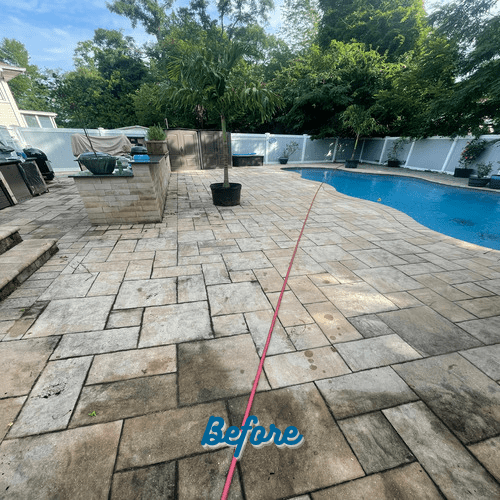
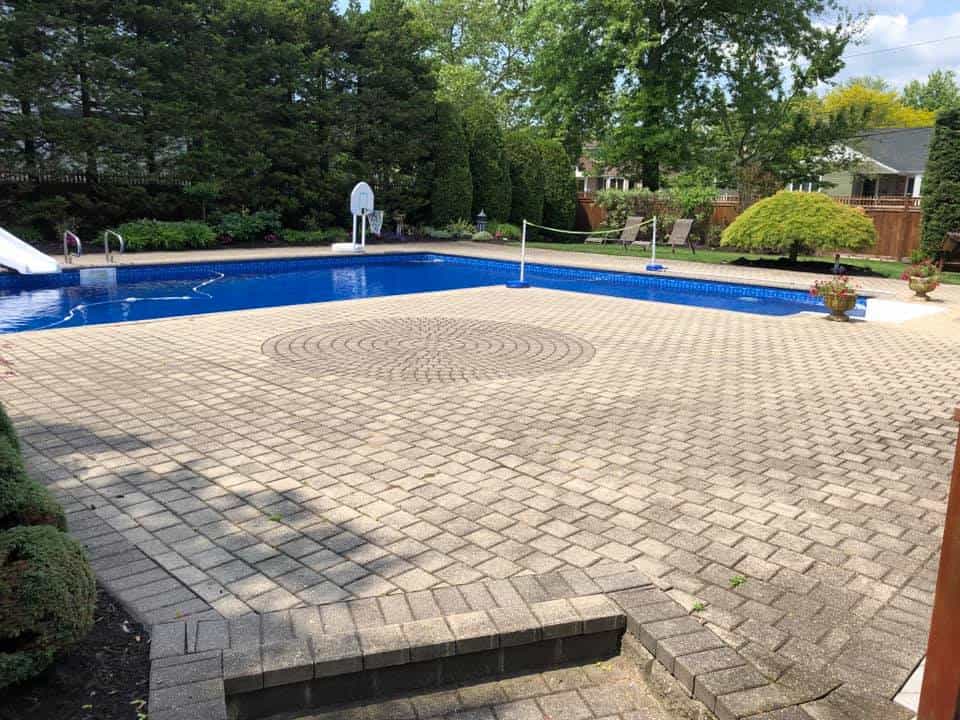
Concrete pavers are the most widely used patio material in Nassau County, and for good reason. When they’re manufactured to a high standard — we’re talking compressive strengths above 8,000 PSI — they handle freeze-thaw cycles well, they’re available in a wide range of styles and colors, and they’re more affordable than most natural stone options. Brands like Cambridge Pavingstones and Nicolock, which is actually manufactured right here on Long Island, are engineered specifically for the Northeast climate. These aren’t the thin concrete tiles you’d find at a big-box store. Properly installed interlocking concrete pavers on a well-compacted base can last 25 to 50 years. They do benefit from sealing every two to three years to protect against staining, salt penetration, and UV fading — but that’s a manageable maintenance cycle.
Brick pavers bring a classic, warm look that suits a lot of Nassau County’s older colonial and Tudor-style homes. The critical thing to know about brick in this climate is the grade. Only SW-grade brick — Severe Weathering — is appropriate for Long Island winters. MW-grade brick, which is rated for moderate weathering, will deteriorate quickly once freeze-thaw cycles start doing their work. Properly graded brick is durable, holds its color well, and ages gracefully. It does absorb water more readily than concrete, so sealing is important, and efflorescence — that chalky white mineral deposit — is a common issue on older brick surfaces that haven’t been maintained.
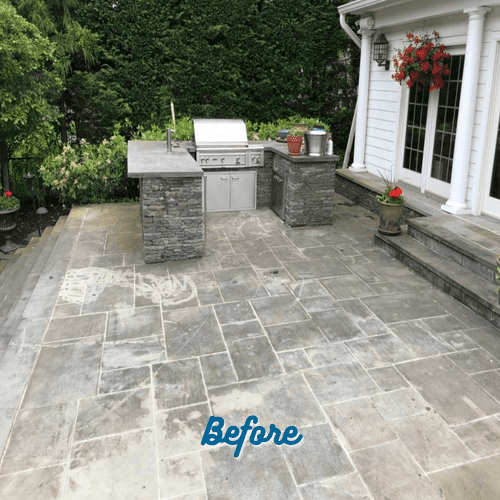
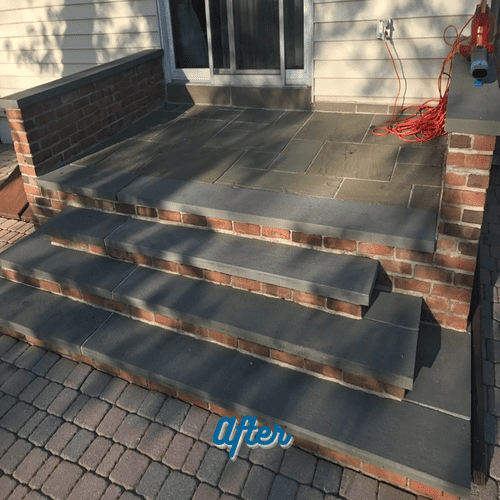
Bluestone is, in many ways, the material that defines Nassau County hardscaping. Drive through Garden City, Great Neck, Manhasset, or Roslyn and you’ll see it everywhere — on stoops, along garden paths, framing mature landscapes around homes that have been there for decades. It’s a dense, durable sandstone with a distinctive blue-gray color and a naturally textured surface that provides good traction. Bluestone handles Long Island’s climate reasonably well, but it is porous, and without proper sealing it will absorb water, stain, and eventually begin to flake in freeze-thaw conditions. Maintained correctly, it’s one of the most beautiful and regionally appropriate materials available.
Travertine, Granite, Porcelain, and Flagstone: Which Premium Paver Is Worth It?
Travertine has become the go-to pool deck material in newer Nassau County installations, particularly in the Mediterranean-influenced homes across parts of the North Shore. It stays cool underfoot even in direct sun, has a refined, upscale look, and is softer and more comfortable to walk on barefoot than granite or concrete. The trade-off is that travertine is highly porous. Left unsealed, it absorbs water readily — and in a freeze-thaw climate, that absorbed water expands, contracts, and eventually causes surface cracking and pitting. Travertine around a pool or on a patio in Nassau County needs to be sealed properly and maintained on a regular schedule. When it is, it performs beautifully and lasts for decades.
Granite is the most durable natural stone option available for patios. It’s dense, nearly impervious to water absorption, and holds up exceptionally well against freeze-thaw cycles and salt exposure. For South Shore communities like Long Beach, Atlantic Beach, and Oceanside — where salt air off the ocean is a genuine daily factor — granite is one of the most resilient choices you can make. It’s also one of the more expensive options, and its hard surface can feel unforgiving underfoot compared to travertine or bluestone. But if longevity with minimal maintenance is the priority, granite earns its cost.
Porcelain pavers have grown significantly in popularity over the last several years, and the performance data backs up the interest. Porcelain has virtually zero water absorption, which means freeze-thaw cycles have almost no effect on the material itself. It doesn’t require sealing, it resists staining, and it holds its color without fading. The main considerations are cost — porcelain runs higher than concrete pavers — and installation, which requires a more precise base preparation. Outdoor-rated porcelain also needs to be textured for slip resistance, so make sure you’re specifying the right product. For Nassau County homeowners who want a low-maintenance, high-performance patio surface, porcelain is worth the conversation.
Flagstone is a broad category that includes various flat, irregularly shaped stones — sandstone, slate, quartzite, and others. It creates a natural, organic look that suits informal garden settings and landscape-integrated patios well. The performance varies significantly by stone type. Sandstone, for example, is relatively soft and porous, making it a poor choice for Long Island’s climate without very consistent maintenance. Quartzite and slate are denser and more durable. If you’re drawn to the flagstone aesthetic, the specific stone type matters more than the category name.
Paver Types for Driveways: What Changes When Vehicles Are Involved
Patio pavers and driveway pavers aren’t interchangeable. A driveway needs to support the weight of vehicles — typically requiring pavers that are 60 to 80 millimeters thick, compared to the 30 to 40 millimeters used for pedestrian patios. The base preparation requirements are also more demanding, and the material needs to handle not just foot traffic and weather, but the compressive stress of a car or truck sitting on it daily.
Belgium block — sometimes spelled Belgian block — is one of the most recognizable driveway materials in Nassau County. You’ll see it used as edging, border material, and full driveway surfaces throughout the county’s older neighborhoods. It’s extremely durable, handles vehicle load without issue, and ages in a way that actually improves its character over time. Concrete pavers in appropriate thicknesses are also a strong driveway choice, and they offer more flexibility in pattern and color than natural stone.

What Makes a Driveway Paver Hold Up on Long Island Roads and Winters?
The base is everything. A well-chosen paver material installed on a poorly prepared base will fail — it’s not a question of if, but when. In freeze-thaw climates like Nassau County’s, the base needs to be six to ten inches of machine-compacted gravel that drains properly. Water that pools beneath the surface will freeze, expand, and push pavers up and out of alignment. This is why you see driveways and patios across Long Island with sections that have shifted, sunk, or cracked — not always because the pavers themselves failed, but because the foundation beneath them wasn’t built to handle what Long Island winters actually deliver.
De-icing salts compound the problem. Salt is corrosive to paver surfaces, particularly concrete and natural stone. If your driveway or patio is regularly treated with rock salt in winter, the surface needs to be properly sealed before the season starts. A quality sealer creates a barrier that prevents salt from penetrating the paver material and causing surface deterioration. This is one of the most overlooked aspects of paver care in Nassau County — homeowners spend money on installation and then unknowingly accelerate deterioration every winter by salting an unsealed surface.
Permeable pavers are worth mentioning here as well. These are interlocking pavers with open joints that allow water to pass through the surface and into a specially prepared base below, rather than running off into storm drains. Nassau County has significant impervious surface coverage, and permeable options are increasingly relevant for homeowners dealing with drainage issues or looking to meet local stormwater requirements. They require a specific base design and regular joint maintenance, but for the right property, they solve drainage problems that no other hardscape option addresses as cleanly.
How Do Different Paver Types Hold Up After Years of Nassau County Winters?
This is the question most homeowners don’t think to ask until they’re already dealing with the answer. The honest reality is that every paver material requires some level of maintenance to reach its potential lifespan — and the maintenance requirements vary significantly by material.
Concrete pavers that are cleaned and sealed on a regular schedule can last 30 to 50 years. Without sealing, they’ll fade, stain, and become increasingly porous as the surface wears. Efflorescence — that white, chalky mineral deposit that appears on the surface — is common on concrete and brick pavers that haven’t been properly maintained. It’s not a structural problem, but it’s a persistent cosmetic one, and it’s a sign that water is moving through the material in ways it shouldn’t be.
Natural stone pavers — particularly travertine, bluestone, and limestone — are more vulnerable to neglect than most homeowners expect. The assumption that natural stone is inherently tough and self-sufficient isn’t accurate. These materials are porous, and in Nassau County’s climate, that porosity matters. A travertine patio that hasn’t been sealed will start showing freeze-thaw damage within a few winters. Bluestone that’s been left unsealed in a shaded area near trees will develop moss and algae growth that, over time, works its way into the surface and causes staining and deterioration.
The good news is that most paver surfaces — even ones that have been neglected for years — can be restored without full replacement. Cracked joints can be re-sanded with polymeric sand. Shifted or sunken pavers can be lifted, the base re-compacted, and the stones reset. Stains, efflorescence, and organic growth can be removed with the right cleaning approach and equipment. What looks like a replacement job is often a restoration job, and the difference in cost is significant. We’ve seen very few surfaces that couldn’t be brought back.
What's the Right Paver for Your Nassau County Patio or Driveway?
There’s no single right answer — it depends on your budget, your home’s style, how much maintenance you’re willing to do, and where on Long Island you live. A South Shore homeowner in Oceanside dealing with direct salt air exposure has different priorities than someone in Plainview or Bethpage. But across all of it, the common thread is this: the material choice matters less than the installation quality and the maintenance that follows.
The most expensive natural stone installed on a poor base will fail. A well-chosen concrete paver, properly installed and sealed every few years, will outlast it. What keeps pavers looking good and performing well isn’t just what they’re made of — it’s how they’re cared for after the installation crew leaves.
If you’re not sure what type of pavers you have, how they’re holding up, or what they need, reach out and we’ll give you a straight answer. We’ve been working with Nassau and Suffolk County homeowners for over 20 years, and we know what Long Island does to hardscape surfaces.
Article details:
- Published by:
- Paver Savers
- Published to:
- Last modified:
- July 2, 2026
Share:
Continue learning: