Paver Replacement Cost vs Restoration: Smart Choice
Replacing pavers costs far more than most homeowners expect. Here's how to know whether restoration is the smarter move for your Long Island property.
Share:
Summary:
You’re staring at a driveway or patio that’s seen better days. The color’s gone flat, weeds are pushing through the joints, and maybe a few stones have shifted. You’re wondering whether to fix what’s there or start fresh — and you’re not sure which answer is going to cost you more in the long run.
That’s exactly the right question to be asking. And the answer depends on factors most contractors won’t walk you through honestly. We will. With nearly 50 years of combined experience assessing and restoring pavers across Nassau County, we’ve seen what each option actually delivers — and what it actually costs.
Paver Restoration vs Replacement: What the Numbers Actually Look Like
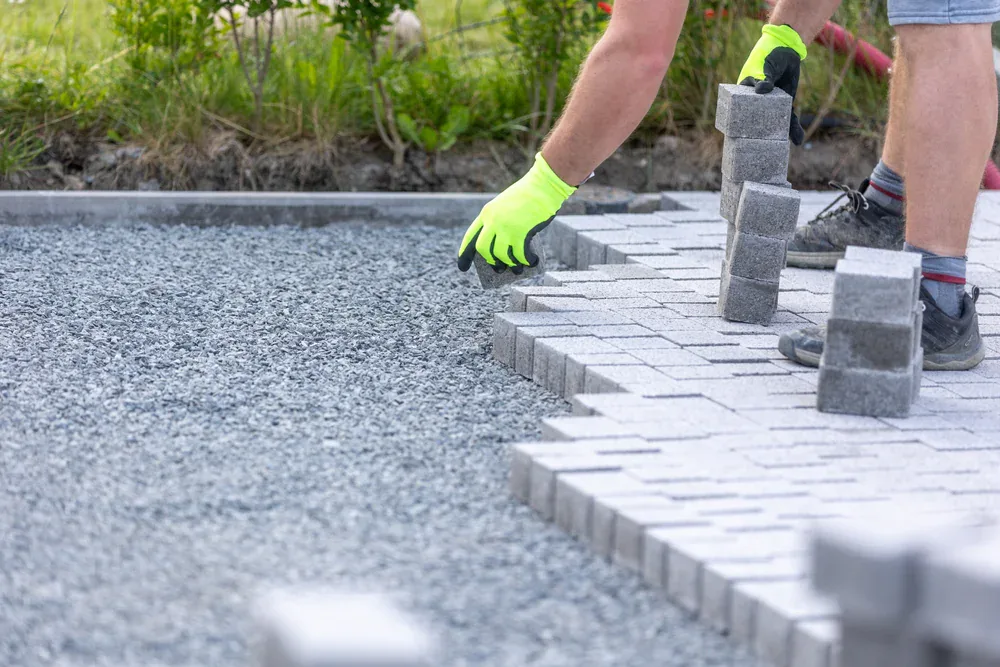
Full paver replacement in Nassau County — materials, demolition, base prep, and labor — typically runs between $20 and $55 per square foot installed. For a standard 400-square-foot patio, that’s $12,000 to $18,000 or more. A two-car driveway can push $21,000 before you factor in grading, drainage corrections, or disposal of the existing surface.
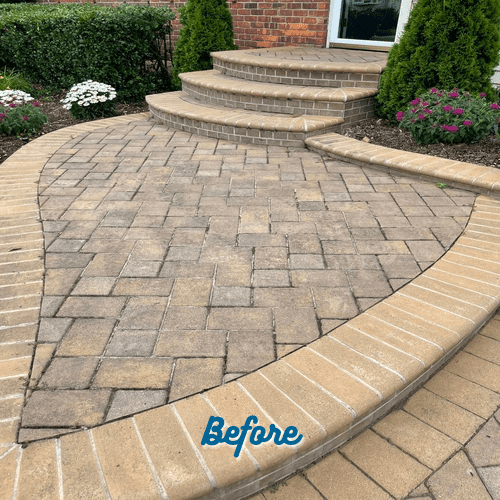
Professional restoration of the same area — thorough cleaning, joint stabilization with polymeric sand, and high-quality sealing — typically costs $1,500 to $5,000 depending on the condition of the pavers and the scope of work needed. That’s not a minor difference. For pavers that are structurally sound, restoration isn’t just the cheaper option — it’s the smarter one.
When to Replace Pavers: Signs the Base Has Actually Failed
There are situations where replacement is the right call, and it’s worth being straight about that. If the base beneath your pavers has failed — meaning the gravel and compacted substrate that everything sits on has shifted, eroded, or was never installed correctly to begin with — surface restoration won’t hold. You’ll clean and seal beautifully, and within a season or two, the pavers will settle, rock, or migrate again.
The signs of genuine base failure are specific. Widespread sinking across large sections, not just a stone or two. Pavers that rock noticeably underfoot. Drainage problems that send water pooling toward your home’s foundation. Edges that have migrated significantly outward because there were no proper restraints installed. In Nassau County’s older suburban neighborhoods — Levittown, Hicksville, Bethpage, and similar communities where paver installations from the late ’90s and early 2000s are now showing their age — we see base failures that stem from under-spec original work. Thin bases, no geogrid, inadequate compaction. When that’s the underlying problem, restoration is a temporary fix at best.
Tree root infiltration is another honest reason to consider full replacement. Nassau County’s mature neighborhoods have large, established trees, and roots that have worked their way under a paver field can cause heaving and displacement that keeps recurring no matter how many times individual stones are reset. In those cases, the root issue has to be addressed at the same time as the base — and that’s a full-scope project.
But here’s what we see more often: homeowners convinced they need full replacement when what they actually have is a cosmetic and joint-stability problem. Fading, staining, algae growth, weed infiltration, and loose joint sand look alarming, but they’re surface-level issues that a proper restoration process resolves completely. The pavers themselves are fine. The base is fine. What’s needed is a thorough cleaning, fresh polymeric sand in the joints, and a quality sealer — not a $15,000 demolition.
Paver Sealing ROI: What You're Actually Protecting Over 10+ Years
Think about what you paid to have your pavers installed. For most Nassau County homeowners, that number is somewhere between $10,000 and $20,000 — sometimes more. Professional sealing every three to five years, at roughly $0.75 to $2.00 per square foot, is the maintenance investment that determines whether that original cost holds its value or compounds into a much larger replacement expense down the road.
Unsealed pavers in Nassau County face a specific combination of threats. Freeze-thaw cycles — temperatures swinging above and below 32°F repeatedly through winter — force water into unprotected joints and beneath the surface, expanding and contracting in ways that gradually displace pavers and erode base material. Salt air in coastal communities like Atlantic Beach, Long Beach, and Lido Beach accelerates the breakdown of joint sand and degrades the paver surface itself. De-icing salt applied in winter causes spalling and discoloration on concrete and natural stone pavers that, without a protective sealer barrier, becomes permanent.
The math over ten years is straightforward. Cleaning and resealing twice in a decade costs roughly $1,000 to $3,000 total for a standard patio. Neglecting maintenance until the surface is beyond restoration means absorbing the full replacement cost — $12,000 to $18,000 or more. The ROI on professional sealing isn’t abstract. It’s the difference between a maintenance cost and a capital expense.
There’s also the home value side of this. Nassau County homes are currently selling at over 101% of list price, and 76% of real estate agents identify curb appeal as the single most important factor in buyer appeal. A driveway or patio that looks clean, sealed, and well-maintained signals that the property has been cared for. One that’s stained, weedy, and faded signals the opposite — and buyers price that in. Paver patios can recoup up to 95% of their cost at resale. That number assumes the pavers are in good condition when the home goes to market.
How We Assess Whether Restoration or Replacement Makes Sense
Before any work begins on a project, we do a full structural assessment. That means checking the base integrity, examining joint condition, identifying the paver material, looking at drainage, and understanding what’s actually causing the visible problems. The assessment drives the recommendation — not a default toward whichever service costs more.
If your pavers can be restored, we’ll tell you exactly what that involves and what it will cost. If they genuinely need replacement, we’ll tell you that too. After nearly 50 years of combined experience, we’ve seen enough projects go wrong — on both ends — to know that the honest answer is always the better one.
What Does a Professional Paver Restoration Actually Include?
This is where the difference between a real restoration and a basic wash-and-seal becomes clear. A proper restoration isn’t just spraying water on the surface and rolling on a sealer. Done correctly, it’s a multi-step process that addresses both the appearance and the structural stability of the paver field.
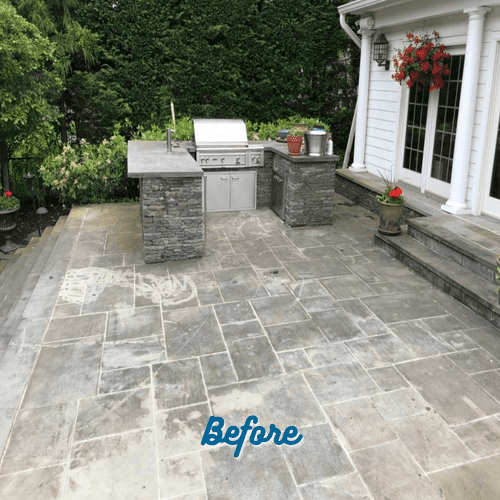
We start with hot water pressure washing using commercial 20-inch surface cleaner equipment — not a standard wand, which creates uneven cleaning patterns and can erode joint sand if used carelessly. The surface cleaner delivers uniform, calibrated pressure across the entire surface, pulling out embedded dirt, algae, efflorescence, oil stains, and organic buildup without damaging the pavers or their joints. Specific stains — rust, oil, mineral deposits — get pre-treated with targeted cleaners before the main wash.
After cleaning, the existing joint sand is removed and replaced with polymeric sand — a product that hardens when activated with water and creates a stable, weed-resistant, ant-resistant joint. This step is non-negotiable for results that last. Skipping it, or using regular sand, is the single most common reason restoration work fails within a season. Finally, a high-quality sealer appropriate for the specific paver material is applied under weather conditions that allow proper adhesion and curing. For sections where individual stones are cracked, displaced, or structurally compromised, we remove and reset those pavers, correct the base material beneath them, and integrate them back into the field before the final sealing step.
The result isn’t a surface that looks “pretty good for its age.” It’s pavers that look genuinely renewed — and are structurally stable enough to stay that way for years.
Nassau County Paver Costs: What Homeowners Here Are Actually Spending
Nassau County is not a cheap market for construction labor, and paver work is no exception. The county’s cost of living runs about 49% higher than the national average, and that premium flows through to every trade. When you see national cost guides quoting $12 to $15 per square foot for paver installation, those numbers don’t reflect what contractors in Garden City, Rockville Centre, or Manhasset are actually charging. Locally, installed paver costs run $20 to $55 per square foot depending on material, design complexity, and site conditions.
That context matters when you’re evaluating restoration. A 500-square-foot driveway that would cost $10,000 to $27,500 to replace can often be professionally restored for $1,500 to $4,000. In communities like Hewlett, Woodmere, and Cedarhurst — where property values are high and homeowners have invested significantly in their hardscaping — that gap is meaningful.
For homeowners in Nassau County’s coastal communities, there’s an added layer. Atlantic Beach, Long Beach, Lido Beach, and Island Park face salt air conditions that accelerate paver deterioration faster than inland areas. Joints break down sooner. Efflorescence appears more frequently. Sealers wear faster. That doesn’t mean replacement is inevitable — it means the maintenance cycle needs to be consistent, and the sealer used needs to be appropriate for coastal exposure. We work in these communities regularly and factor those conditions into every assessment and product recommendation.
One practical note: Nassau County requires contractors performing home improvement work to hold a Nassau County Home Improvement License — a specific local credential separate from general state licensing. It’s worth asking any contractor you’re considering whether they carry it. We do, along with full liability insurance and workers’ compensation coverage. In a county where a single project can represent a $15,000 to $20,000 investment, that’s not a small thing.
We also offer financing for restoration and replacement projects, because the right decision shouldn’t be delayed because of timing. Waiting a season while pavers continue to deteriorate almost always means a higher bill when the work finally gets done.
Restoration or Replacement? Here's How to Make the Right Call for Your Nassau County Pavers
Most homeowners who search for paver replacement cost end up discovering they don’t actually need full replacement. What they need is an honest assessment from someone with enough experience to tell the difference — and a restoration process thorough enough to deliver results that hold.
The cost gap between restoration and replacement in Nassau County is significant. The long-term value of maintaining pavers versus neglecting them is even more significant. And the difference between a restoration that lasts and one that fails within a year comes down entirely to process — the cleaning method, the joint stabilization, the sealer quality, and the structural work done before any of that happens.
If your pavers are faded, stained, weedy, or uneven and you’re not sure which direction makes sense, reach out to us. We’ll take a look, give you a straight answer, and walk you through exactly what the work involves and what it will cost — before you commit to anything.
Article details:
- Published by:
- Paver Savers
- Published to:
- Last modified:
- August 27, 2026
Share:
Continue learning: