3 Common Paver Repair Emergencies in Nassau County: Visual Guide to Our Solutions
Nassau County's most common paver emergencies: cracked pavers, edge restraint failure, and joint problems. See real solutions from licensed repair specialists.
Share:
Summary:
Cracked Paver Replacement: Nassau County's #1 Repair Emergency
Cracked pavers are the emergency call we get most often in Nassau County. You wake up to find your beautiful patio or driveway marred by zigzag cracks running through individual stones. Sometimes it’s just one paver, other times you’ll spot several damaged stones clustered together.
The visual is unmistakable: clean breaks, hairline fractures, or chunks missing from corners. What you’re seeing is usually the result of our harsh Long Island freeze-thaw cycles, where water gets into tiny pores, freezes, expands, and literally breaks the stone from the inside out.
But here’s what most homeowners don’t realize: cracked pavers are often a symptom, not the root cause. Poor base preparation, inadequate drainage, or shifting soil beneath your pavers creates stress points that make cracking inevitable.
Why Nassau County Pavers Crack More Than Other Areas
Nassau County sits in a unique position where coastal moisture meets inland temperature swings. This creates the perfect storm for paver damage. Our winters bring repeated freeze-thaw cycles that most paver installations simply aren’t prepared to handle long-term.
When water penetrates your pavers—through tiny pores, hairline cracks, or failed joint sand—it becomes a ticking time bomb. Every time temperatures drop below 32 degrees, that trapped water expands with tremendous force. Over multiple seasons, even the highest-quality pavers develop stress fractures.
The coastal influence adds another layer of complexity. Salt air accelerates the breakdown of protective sealers, leaving pavers more vulnerable to moisture penetration. Combined with the heavy traffic many Nassau County driveways and patios see, you get accelerated wear that shows up as cracking.
We’ve repaired thousands of cracked pavers across Nassau County, and the pattern is consistent: installations that looked perfect for years suddenly develop multiple cracks within a single harsh winter. The good news? Proper repair addresses both the visible damage and the underlying causes, preventing future problems.
Our Cracked Paver Replacement Process
Nassau County sits in a unique position where coastal moisture meets inland temperature swings. This creates the perfect storm for paver damage. Our winters bring repeated freeze-thaw cycles that most paver installations simply aren’t prepared to handle long-term.
When water penetrates your pavers—through tiny pores, hairline cracks, or failed joint sand—it becomes a ticking time bomb. Every time temperatures drop below 32 degrees, that trapped water expands with tremendous force. Over multiple seasons, even the highest-quality pavers develop stress fractures.
The coastal influence adds another layer of complexity. Salt air accelerates the breakdown of protective sealers, leaving pavers more vulnerable to moisture penetration. Combined with the heavy traffic many Nassau County driveways and patios see, you get accelerated wear that shows up as cracking.
We’ve repaired thousands of cracked pavers across Nassau County, and the pattern is consistent: installations that looked perfect for years suddenly develop multiple cracks within a single harsh winter. The good news? Proper repair addresses both the visible damage and the underlying causes, preventing future problems.
Paver Edge Restraint Failure: When Your Patio Starts Walking Away
Edge restraint failure looks exactly like it sounds: your pavers are literally walking away from where they belong. You’ll notice the perimeter stones spreading outward, creating gaps between pavers that weren’t there before. Sometimes the entire edge looks like it’s leaning or tipping away from the main surface.
This emergency develops gradually, then accelerates rapidly. What starts as a barely noticeable gap becomes a tripping hazard within a single season. Left unchecked, edge restraint failure can compromise your entire paver installation, requiring complete reconstruction instead of targeted repair.
The root cause is almost always inadequate or failed edge restraint systems. Many installations rely on cheap plastic edging that becomes brittle in our Long Island weather, or worse, no edge restraint at all.
Signs Your Nassau County Pavers Need Edge Restraint Repair
Edge restraint failure doesn’t happen overnight, but Nassau County homeowners often miss the early warning signs until the problem becomes an emergency. The first indicator is subtle: individual pavers around the perimeter that seem slightly out of alignment with the rest of the surface.
As the failure progresses, you’ll notice actual gaps appearing between stones. These gaps typically start small—maybe a quarter-inch—but expand rapidly once the restraint system loses its grip. The pavers aren’t just shifting sideways; they’re also losing their interlock with neighboring stones, which destabilizes the entire area.
In severe cases, you’ll see pavers that have tilted or dropped noticeably below the surrounding surface level. This creates obvious tripping hazards and allows water to pool in areas where it shouldn’t, accelerating further damage. Some homeowners describe it as their patio “spreading” or “melting” away from the center.
The problem accelerates during Nassau County’s freeze-thaw cycles. Ground movement puts additional stress on already compromised edge restraints, often causing complete failure during a single harsh winter. We’ve seen perfectly stable-looking installations lose multiple perimeter pavers after just one bad freeze.
What makes this particularly frustrating for homeowners is that the damage often appears suddenly, even though the underlying restraint system has been failing gradually for months or years. One day everything looks fine, the next day you have a major repair emergency on your hands.
How We Fix Failed Edge Restraints Permanently
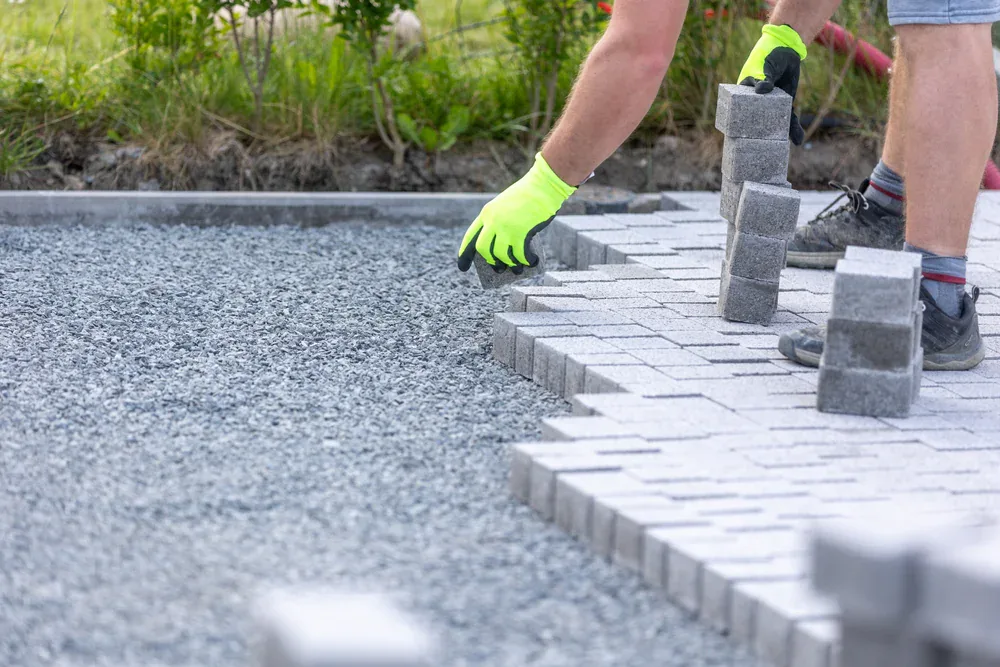
Repairing failed edge restraints requires more than just pushing pavers back into place. We’ve learned that temporary fixes create bigger problems down the road, so our approach addresses the entire restraint system from the ground up.
First, we remove all affected pavers in a radius around the problem area. This gives us access to the existing restraint system and allows us to assess the base condition underneath. Most failures we encounter stem from restraints that were installed on the bedding layer instead of the compacted base—a shortcut that guarantees eventual failure.
We excavate down to the proper depth, exposing the base material where the new restraint system will be anchored. The restraint must sit on the same solid foundation as your pavers, not on the sand layer above it. This principle is non-negotiable for long-term performance in Nassau County’s challenging conditions.
Our restraint system selection depends on your specific application and traffic requirements. For high-traffic areas like driveways, we use heavy-duty restraints anchored with steel spikes driven at precise angles into the compacted base. For patios and walkways, we might choose flexible restraints that can accommodate slight ground movement without failing.
Installation requires precise positioning—the restraint must be tight against the pavers while maintaining proper height relationships. We secure the system at recommended intervals, ensuring each anchor point can handle the lateral forces your pavers will experience over time.
The final step involves backfilling and compacting around the new restraint system, then reinstalling your pavers with fresh bedding sand and polymeric joint fill. The result is an edge restraint system that will contain your pavers through decades of Nassau County weather extremes.
Professional Paver Repair: Your Nassau County Investment Protection
These three paver emergencies—cracked stones, edge restraint failure, and joint problems—account for nearly 80% of the repair calls we handle in Nassau County. The good news is that all three are completely preventable with proper installation and maintenance, and all three are repairable when addressed promptly by experienced professionals.
What separates emergency repairs from planned maintenance is timing and cost. Catching these problems early means targeted fixes that preserve your investment. Waiting until they become obvious emergencies often means more extensive repairs and higher costs.
If you’re seeing any of these warning signs on your Nassau County property, don’t wait for the problem to accelerate. We have the experience, tools, and materials to address these emergencies properly the first time, protecting your paver investment for years to come.
Article details:
- Published by:
- Paver Savers
- Published to:
- Last modified:
- December 4, 2025
Share:
Continue learning: